

This article written by Arlene Stafford.
From Lanark County Farm Boy to ‘The Apostle of Temperance’
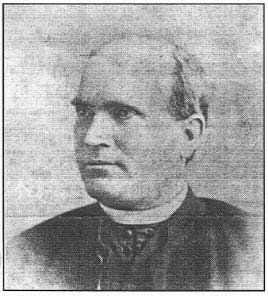
It was at the first blush of morning, when the earliest signs of the new day appeared, that Michael felt closest to God. As somber skies faded from shadowy hues to a soft pink glow, the luminous rays of the faithful sun rose triumphantly, like an unspoken promise of new beginnings. To him, each day was a precious gift. With his devout nature, he felt humbled by the beauty that surrounded him, and grateful to be granted another measure of time on earth…to live, to serve, and to contribute whatever he could in his own small way. On mornings like these, he often gazed toward the heavens and prayed, “This is the day that the Lord thy God has made. Thanks be to God.”
Michael’s beloved horse, Patch, was the only one on earth to hear his prayer that morning, so many years ago. He reached down, patted his neck, pulled the reins gently, and turned toward home. When the weather was fine, he would ride for miles through the countryside, enjoying the beauty of the landscape, and the cheerful chorus of birdsong. His favourite place to ride was Hutton’s Grove, not far from the town of Lindsay, where he was the parish priest.
There was something familiar about Hutton’s Grove that reminded him of home, and of his youthful days on the farm, in Lanark County. Michael was born, March 1st, 1832, on the 11th concession of Drummond Township, along the banks of the Mississippi River, about 8 miles from Perth. His parents hailed from Ireland – his father, Tobias Stafford came from County Wexford, and his mother, Elizabeth ‘Betsy’ McGarry, was from County Westmeath.
Michael’s father, Tobias, had fought for Irish separation, and it was one of the reasons he’d come to Upper Canada, weary of the British influence. When Malcolm Cameron, who lived a mile from the Stafford homestead, ran for office against the Family Compact, he received hearty support from Tobias, an earnest Reformer. Tobias worked tirelessly on Malcolm’s campaign, and so, Michael grew up in a home where politics, justice, equality, and reform in particular, were discussed at length.
Until the age of 14, Michael attended a district school, near the village of Lanark. His teacher, Robert Lees, an accomplished academic, later served in the office of County Attorney for Carleton. The makeshift schoolhouse was an abandoned lumber shanty, in dire need of repair. The crude seats were constructed of basswood logs, hewn flat on one side. The desks were fashioned from holes bored in the sides of the building, pegs had been driven in, and unplaned boards laid on the pegs. Despite these humble beginnings, Michael was a keen student who excelled at reading, had a gift for writing poetry and prose, and developed an unquenchable thirst for learning that would see him continue on the path of education for many years beyond his youth.
After his early days in the country schoolhouse, Michael was promoted to the district school in the town of Perth, where he studied for two years, then he headed off to Chambly, for one year, where he was educated in the French language. The next six years were spent studying at St. Therese College in Montreal. After much reflection, and a growing awareness of being drawn toward the church, he moved to Kingston, and entered the stream of ecclesiastical study at Regiopolis College. Michael completed the curriculum, and was ordained a priest, in 1858, at the age of 26.
Toward the end of his program he was appointed to act as Assistant Chaplain at the Kingston Penitentiary. It was during this time he began to see the relationship between alcohol and crime, although it was not until many years after that he became a total abstainer. He pressed the administration of the prison for statistics on the offenders, and after careful inquiry he ascertained that approximately ninety per cent of the convicts were sent there with the abuse of alcohol as the direct cause of their crimes. This was a pivotal lesson for Michael, and in the years to come, preaching abstinence would become his life’s mission.
Time after time during his course of studies in Kingston he had demonstrated his academic excellence and leadership abilities, and so it was no surprise to his peers that he was immediately appointed to the position of Director of Regiopolis College. In addition, he also agreed to fill the seat as Chair of Logic and Philosophy, and became a Professor of Philosophy and Metaphysics. He was content at this stage in his life to remain in the academic world, rather than take on a parish position.
By his late twenties Michael began to suffer from severe chest pain. Doctors told him it was caused by an inadequate blood flow to his heart. It wasn’t long before his overall health began to fail. His peers could see that he tired easily and struggled with basic physical tasks. The simple act of climbing stairs became a challenge, and he was often seen pausing on a stairway to catch his breath. The harsh Eastern Ontario climate always worsened his symptoms, and his fellow students and colleagues in Kingston were concerned that he might not make it through another winter.
The Vicar General decided it would be beneficial to bring Michael to a warmer climate, and so, on a cold, bleak, January day in 1859, they embarked on a journey, with the intention of travelling to Cuba, and learn whether a warmer climate would improve his condition.
Michael tired easily during their travels through the northern states, and as they ventured farther south, he found his breathing became more laboured. They journeyed as far as Charleston, South Carolina, but Michael couldn’t tolerate the increasing heat; and so, they began to travel up into the Pine Ridge area, along the Pee Dee River. They found accommodations, and decided to spend the remainder of the winter there.
It was during the winter of 1859 that Michael observed for the first time, men and women being held as slaves. Michael learned that area farmers purchased people of African origin, and held them against their will, forcing them to labour without pay, on farms, growing cotton, rice, and corn. Although he recalled hearing news of this practice during his years in school, he had never observed it firsthand. On a visit to Richmond, Virginia, he was horrified to witness an auction sale of slaves, downtown, in the market square. He wasted no time in making his way through the crowds to the center of the proceedings and was very vocal in expressing his strong disapproval. He stated aloud for all to hear that this was not a moral practice, treating God’s children in this way. Local merchants and farmers stared at him impatiently, angered by the disruption. Within a few brief minutes of his outburst, local police officers appeared on the scene, and he was chastised and subdued. He was warned to cease his unwelcome comments, and the officers accused him of being from the Northern States. He denied their accusations, and stated that he was a British subject visiting from Upper Canada. The Vicar took his arm firmly, and led him away, cautioning him not to strain his heart in this way, in his weakened physical state. This incident would stay with Michael, and in the years to come he spoke out against this shameful and unethical practice. He emphasized that love and good will shall be for all of God’s people.
By the time spring arrived, Michael and the Vicar did not wish to spend anymore time in the southern states, and they travelled from there to Europe, spending the summer in Ireland, England and France. When he returned to Kingston in September, he was completely restored to good health, and ready to return to work. He resumed his position as professor of Logic, Metaphysics and Ethics, and remained for the school year. In the fall he was dispatched to Picton, to serve in place of their parish priest who had fallen ill. He remained in Picton for nine months, and from there he was posted to Kemptville for six months, to fill in while their parish priest was on sick leave. He did well in his role as spiritual leader in these communities, and when his time was completed in Kemptville, he was appointed to take over the parish at Wolfe Island.
Michael enjoyed his time at Wolfe Island. He was both surprised and pleased to have a congregation of total abstainers. None of the members of the church had drank any alcohol in at least a decade, and Michael observed the civil behavior, lack of arguing, fighting, and that there were no beggars among them. He also noted that the schools were doing well, and that the children were benefitting greatly from their stable home life.
In May 1868 he was appointed as the parish priest of Lindsay. Once he settled in, he was disturbed to see that the schools were behind, the houses were poorly maintained, the people were not as well educated, and that there was an enormous amount of money being spent on alcohol. There were eight taverns in the township, and he learned that a number of the members of his congregation had lost their farms through the consequences of drinking. He decided to organize a total abstinence society, and by the end of the first year, over 900 of the local residents had taken a pledge to stop drinking alcohol. Michael noted with pride that the ‘shebeens’ were disappearing. Shebeen was an old Irish term referring to a disreputable establishment selling liquor.
As the bars and taverns disappeared one by one, the farms improved, and brick school-houses replaced old log buildings, and the township eventually ranked as one of the best in the province.
“His ceaseless fight against the universal drunkenness which debauched and impoverished the countryside is due more credit than any other single factor for the present prosperity of the county.”
In 1869, Michael, age 37, realized there was a dire need for a decent separate school in the community. The existing school in Lindsay was a poor shabby-looking structure with capacity for only 100 students. He immediately spearheaded a project to establish a modern separate school in Lindsay. With funding in place, construction progressed quickly, and the school was ready to open. The new school, named St. Dominic’s, was a fine sturdy brick structure, designed to accommodate twice the number of students. Within the first year of its opening, the school was filled to capacity by new students. To encourage academic excellence at the new school, Michael, set up a yearly academic achievement award, donating twenty dollars (around $500 in today’s value) as prize money.
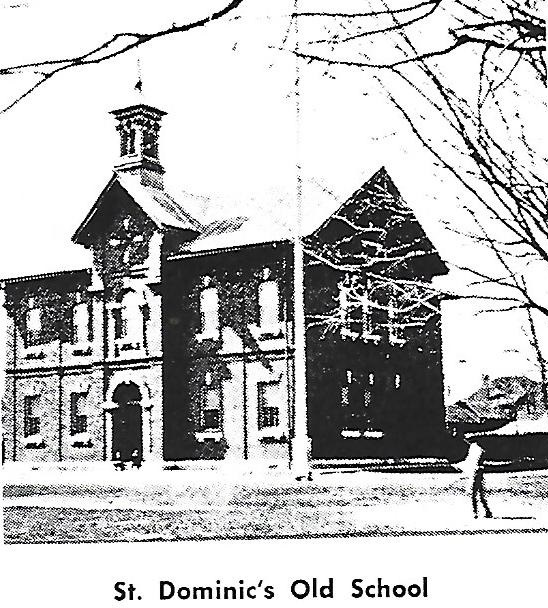
“He would take up the work of the school and hear the different classes recite – His method of imparting knowledge made him a popular teacher. His skill in drawing out the little ones delighted the studious and shamed the idle. These same schools owed their superiority to him.”
In addition to founding St. Dominic’s School, he was also the driving force in establishing the Loretto Convent in Lindsay, built a few years later, in 1874, at a cost of $60,000. Aware of the career-oriented programs in the public schools, it was Michael’s intention to provide a decidedly more academic institution than had previously existed for nuns at that time. Mother Teresa Dease, foundress of the Loretto Order, was not keen on Father Michael Stafford’s suggestion that the sisters of Loretto should vary from their usual course of studies. It was also Father Stafford’s intention that the convent’s teachers be certified, and that the academic programs be offered to young women who may or may not choose to join the Order. Mother Dease was “loathe to sacrifice her pupils’ reputations for oratory, languages, and music.” She felt that her pupils were not concerned with matriculation.
Archbishop John Joseph Lynch interceded on behalf of Father Stafford to persuade Mother Teresa Dease to accept the mission. This decision caused far-reaching repercussions on the entire religious community. In order to teach at the new Loretto Convent, the Sisters had to be qualified under the Province of Ontario’s education standards. The number of Sisters who possessed the academic background for these positions were few and far between. Most had been educated at convent schools whose objectives were to train the sisters mostly in religious doctrine, and in some cases needlework and basic sewing. At the new Loretto Convent the Sisters had to rely on women who were educated in secular schools prior to their profession of vows. This would be a turning point for how the female religious community regarded itself within the educational framework in Ontario. This was the change that opened the door for the Sisters to move from traditional training deemed suitable for young women, to an academic education leaning more toward a profession. As a result of these reforms introduced at Loretto, the female religious community began to regard those educated at Lindsay as the cream of the crop. In the years to follow, many other Sisters aspired to join this group of elite teachers.
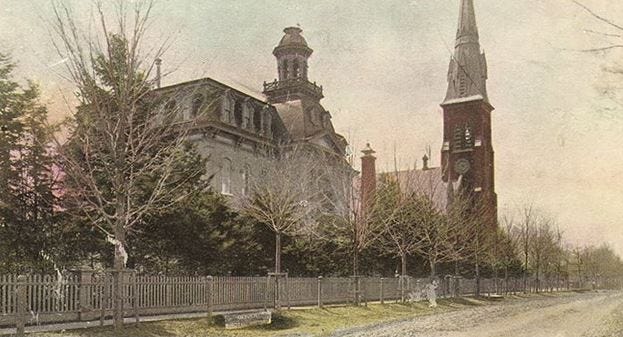
Loretto Convent and St. Mary’s Church, Lindsay, Ontario
Father Stafford also saw the need, with the approval of the Archbishop of Toronto, to have the Department of Education introduce a number of excellent books designed for Roman Catholic Schools into their General Depository. It was during this time that the government wished to appoint Michael as the Head Master of the Ottawa Normal School, when it was first established, but he declined, believing he could make more of an impact in other roles.
Throughout his career Father Stafford submitted countless articles that were published in Canadian, U.S., Irish, and British newspapers, mainly on the subjects of education and temperance. He also toured extensively throughout Ontario, and it was said at the time, “there is no city and hardly a town of any importance in Ontario where he has not lifted up his voice on behalf of one of these causes or both.” He was also invited to speak abroad, and in the summer of 1876, he decided to return to Europe, accepting many of the invitations to address both private and public meetings on the importance of abstinence. In London, England, he lectured at the request of Cardinal Manning to packed halls and meeting rooms. With regards to his style of speaking: “Father Stafford does not strive to produce striking effect by brilliant oratory. He is concise and simple but speaks with an energy and earnestness that makes a deep impression.”
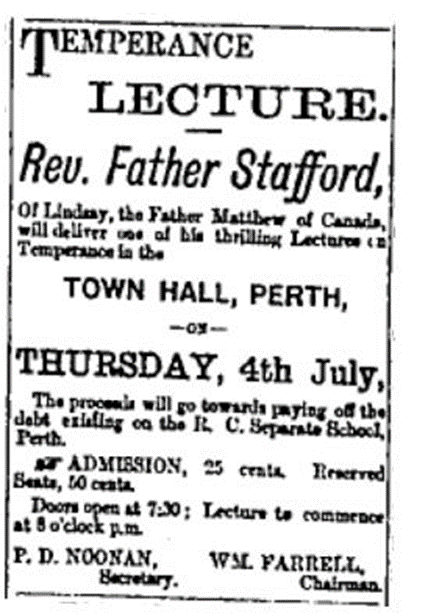
“The Perth Courier”, June 28, 1878, p.1
Some of Michael’s most memorable speeches were in response to the violent protests on July 12th, 1877, in Montreal. There were brutal clashes between some of the more vocal Protestants celebrating Orangemen’s Day, and the Roman Catholic demonstrations objecting to the underlying nature of the yearly commemoration. The clashes resulted in the death of a young man named Hicks, and the severity of the attack was widely reported in Canadian newspapers. Father Stafford was among the first to make a public statement about the protests. The Toronto Telegram, along with countless newspapers published commentaries on his remarks, “Father Stafford will hardly be accused of being the less a Catholic because he counsels good fellowship among Irishmen and tolerance among members of partisan societies. He said it should not be forgotten by the Catholics that the Orangemen are mostly fellow countrymen of their own, and that the quickest way to resolve old feuds and traditions which have come to us from over the sea is not by rousing the spirit of discord, and intolerance, and ill will.”
During his years in Lindsay, Father Stafford used his own funds to establish a parochial library, which became known as the Father Stafford Library. He donated books, purchased many others, and he directed that future funds from his estate were to be used to add new books, and maintain the library. The library was originally located in St. Dominic’s School, and transferred in 1934 to St. Mary’s School, in the Loretto convent.
“It was something to gladden the sight to watch his tall, muscular form passing through the town; his unusual height, his princely carriage marked him immediately; and his broad-brimmed soft felt hat shading the benevolent features was assurance if need were, of his identity. It was delightful to observe the reverence and love of the people – the fraternal care and interest of the pastor; he knew all, whom to comfort, whom to chide, whom to encourage and whom to restrain. His personal appearance suggested the utmost refinement. His hospitality was proverbial; and as freely as he dispensed, as freely did he partake of that of his people.” (written by a Sister of the Loretto Order, 1878)
In June of 1881, in failing health, Michael travelled once again, to Europe. He stayed briefly in London under a physician’s care, and at that time it was suggested to him that he travel to France and partake in the thermal baths. He spent August and September in Vichy, where the city enjoys a mild oceanic climate, with fresh breezes blowing in from the nearby Alps. Vichy had the only volcanic hot spring in France, and the waters were said to contain calcium, copper, iron, and manganese, which were thought to promote regeneration and a feeling of well-being. After his time in Vichy, Michael travelled to Rome, where he was granted time with the Pope. On his return home, he spent a few days in England, and a week in Ireland, and was in Dublin during the riots. Unlike his previous trip, his health had not improved.
Michael’s final illness was brief, and once again, the extreme chest pains, and shortness of breath characterized his long-standing heart condition. In the second week of November, he grew weaker, but continued with his duties, and felt well enough to schedule a meeting with Bishop Jamot, for Monday, November 13th. On Sunday morning, Michael’s health took a turn for the worse, and his colleague, Father Keating, conducted the morning mass in his place.
At noon that Sunday, November 12, 1882, Michael, age 50, passed away. The cause of death was listed as a heart attack, with angina pectoris as an underlying factor.
The funeral was impressive in size, largely attended by both secular and religious dignitaries: Archbishop Lynch, Bishop Jamot, Monsignor Farrelly, a large number of priests, the Honourable C.H. Fraser, the Honourable S.C. Wood, Commissioner of Agriculture for the Province of Ontario, and the Honourable William Harty, Member of Parliament for Kingston. Along with the prominent guests, were a tremendous number of people from Lindsay and the surrounding areas: teachers from the convent, the Sisters of the Loretto Order, pupils, and neighbours and friends from all walks of life.
“His funeral was largely attended by all classes of every denomination, which shows the esteem in which he was held by Protestants as well as Catholics.”
“He will be mourned by all as he had become by virtue of his broad and liberal mind, an earnest peace-loving character, one of the most powerful, if not the most powerful mediator in all kinds of troubles between Roman Catholics and Protestants.” – “Montreal Witness”
“One of the most liberal and tolerant of men, his loss will be deplored by those of all shades of opinion. He has left a void in the direction of practical reformation which will indeed by difficult to fill.” “Toronto Globe”
“It is an honour to this county, that the late Father Stafford was born within its limits, having first seen the light on the old homestead farmhouse, near Ferguson’s Falls, in the Township of Drummond.” “The Perth Courier”
…………..
There was a bitter chill in the air during the dark morning hours, the day after Father Stafford passed away. Jack, the stable-hand, rushed out of the barn; and headed across the property, straight toward the church caretaker standing outside of St. Mary’s. “Have you seen Patch, Father Stafford’s horse? He’s gone.” The weathered old caretaker straightened up, looked around the grounds, and said, “You might try down at Hutton’s Grove; that’s where they rode every morning.”
Jack nodded, returned to the stable, mounted one of the horses, and headed off down the dark road. After a brisk ride on that cold, somber, November morning, Jack finally reached Hutton’s Grove. He guided his horse slowly along the well-worn trail, and as the sky began to brighten, he spotted Patch, at the top of a hill, quietly staring at the horizon.
Jack didn’t know, but Patch did. This was their spot. This was where he and Michael watched the sun rise every morning. This was the place where he and his good companion spent quiet moments together. This was their place; where the pink glow along the horizon changed to gold, where he heard his friend and master speak to God, in his quiet, even, tones.
Patch stood motionless until the first rays of the sun climbed above the horizon, then he paused for a moment, turned, and headed back down the trail toward Jack. He somehow knew that Michael was gone, and had come to say goodbye to his old friend, in the only way he knew how.
……..
Father Michael Stafford, known throughout North America and Europe as the ‘Apostle of Temperance’, was laid to rest in the vault, on the right-hand side of the main alter, at St. Mary’s Roman Catholic Church, in Lindsay, Ontario.
By: Arlene Stafford-Wilson
(My great-grandfather, Thomas Stafford, was the youngest brother of Father Michael Stafford)
……………………………..
Bibliography:
“From the Pioneers To The Seventies: A History of the Diocese of Peterborough 1882-1975”, Edgar J. Boland, Maxwell Review Ltd., 1976.
Correspondence from Reverend Sister Bogdana, c.p., Bishop’s House, Diocese of Peterborough, 350 Hunter St., Peterborough, ON, Sept. 22, 1998.
St. Mary’s Parish Newsletter, vol.2, No.3, “The Loretto Convent 1874-1890”, Sister Kathleen Harrigan, C.S.J., June 1998.
“The Rev. Michael Stafford”, by M.E. ‘Celestine’ Stafford, published by “The Renfrew Advance”, Aug. 7, 1947.
The Canadian Biographical Dictionary and Portrait Gallery of Eminent and Self-Made Men, Ontario, Volume 1. Toronto American Biographical Pub. Co. 1880
“The Canadian Portrait Gallery vol. 2, The Reverend Michael Stafford, p. 494-496
“Victoria County Centennial History, Chap. XIV, biographies, p. 206.
1959 Centennial Book, and St. Mary’s Parish newsletter, provided by Helen Humphries, 53 St. Lawrence St., Lindsay, Ontario, Aug. 1998.
“Catholics at the Gathering Place: Historical Essays on the Archdiocese of Toronto 1841-1991”, University of St. Michael’s College, 1990, pg. 93-94.
“The Pilot”, 25 November 1882, front page, Boston, Mass. U.S.A
“Piety and Nationalism”, Brian P. Clarke, McGill-Queen’s University Press, Kingston,1993
“Ottawa Daily Citizen”, Aug. 15, 1877, p.4
“The New York Times”, N.Y., Nov. 13, 1882, p.1